
Stop guessing why some perfumes last all day while others vanish in an hour. This complete guide breaks down every fragrance concentration – so you can buy with confidence and never overpay for weak juice again.
Why Concentration Matters More Than the Bottle
You have seen the letters: Parfum, EDP, EDT, Cologne. They are printed on almost every fragrance box. But most people ignore them – and then wonder why a $150 “perfume” fades before lunch.
Here is the truth:
The concentration of aromatic compounds (the actual perfume oils) is the single biggest factor in how a fragrance performs. It determines:
- How long it lasts on your skin (longevity)
- How far it projects (sillage)
- How much you need to apply
- And often, the price
But the industry uses confusing terms. Parfum vs. EDP – which is stronger? Is “Cologne” only for men? And what about “Eau Fraiche” or “Perfume Oil”?
This cheat sheet answers all of those questions. Consequently, by the end, you will be able to look at any bottle and know exactly what to expect – without ever spraying it first.
What Is Fragrance Concentration? (The Simple Definition)
Fragrance concentration is the percentage of pure perfume oil (the aromatic compounds) dissolved in alcohol and water.
Think of it like juice concentrate:
- High concentrate = strong flavor, a little goes a long way, lasts longer.
- Low concentrate = lighter flavor, you need more, fades faster.
In perfumery, the higher the oil percentage:
- ✅ Longer longevity (hours on skin)
- ✅ Stronger projection (people can smell you from farther away)
- ✅ More complex scent development (top/heart/base notes are more distinct)
- ❌ Higher price per bottle
- ❌ Can be overpowering if you apply too much
Lower concentration gives you:
- ✅ Lighter, fresher feel (great for summer or office)
- ✅ Lower price
- ✅ Easier to reapply throughout the day
- ❌ Shorter wear time (2–4 hours typical)
- ❌ Less sillage (stays close to skin)
The Complete Concentration Cheat Sheet (At a Glance)
Here is your master table – save it, print it, bookmark it.
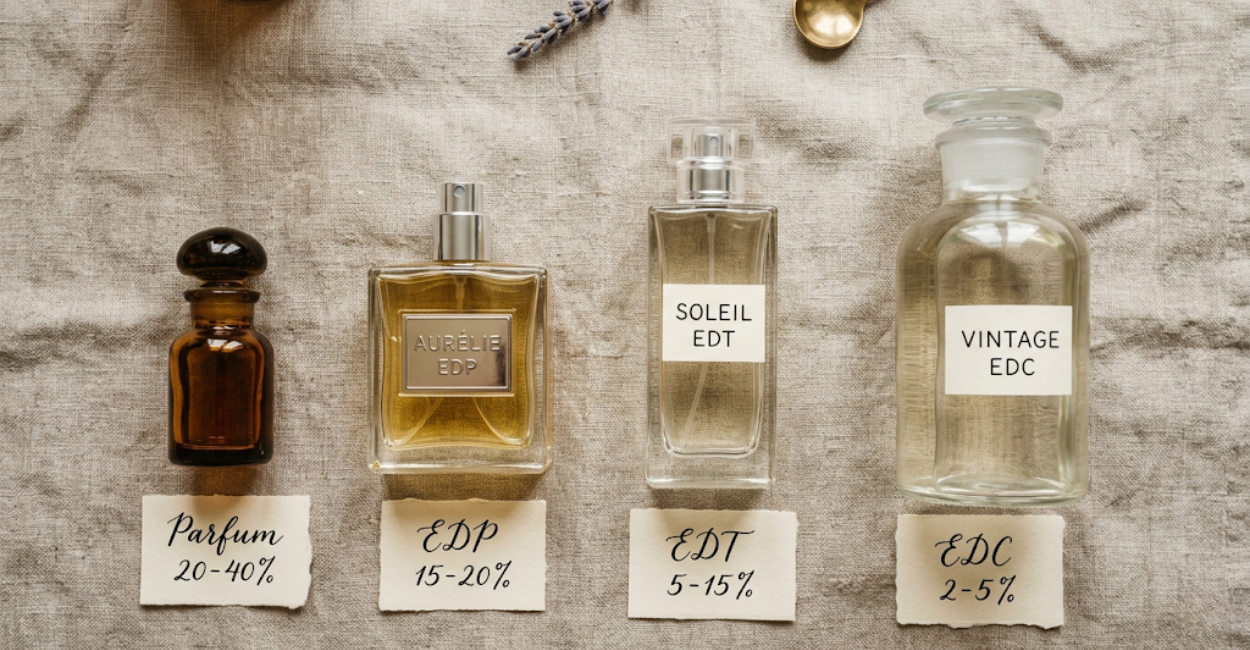
| Concentration | Perfume Oil % | Longevity (Hours) | Projection | Best For | Typical Price (50ml) |
|---|---|---|---|---|---|
| Parfum (Extrait de Parfum) | 20–40% | 8–12+ | Low to Moderate (skin scent after 2-3 hours) | Evening, winter, special occasions | $150–500+ |
| EDP (Eau de Parfum) | 15–20% | 5–8 | Moderate (arm’s length) | Everyday, all seasons | $80–200 |
| EDT (Eau de Toilette) | 5–15% | 3–5 | Light to Moderate (close to skin) | Daytime, office, warm weather | $50–120 |
| EDC (Eau de Cologne) | 2–5% | 2–3 | Light | Casual, gym, after shower | $30–80 |
| Eau Fraiche | 1–3% | 1–2 | Very Light (skin scent only) | Splash on after bath, hot climates | $20–50 |
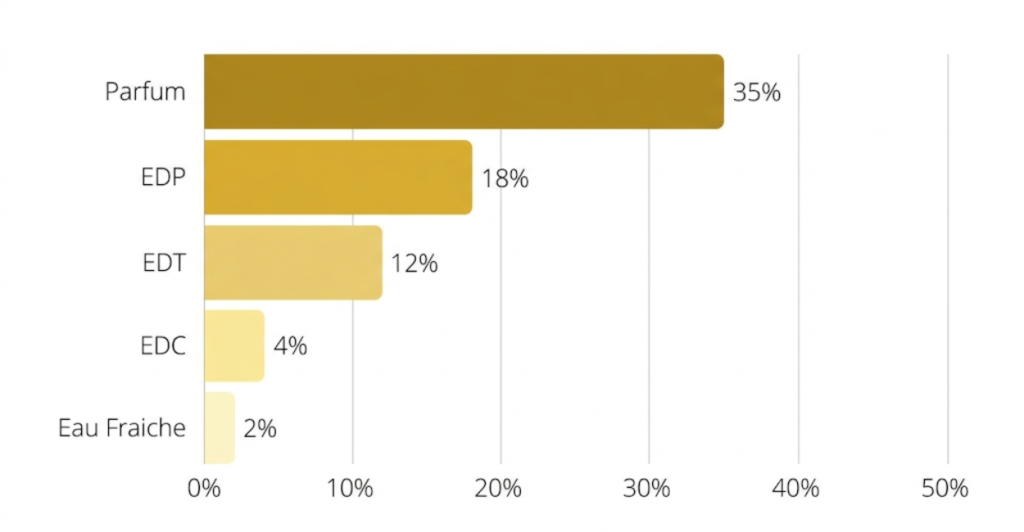
Note: Percentages vary by brand. Some “EDP” from designer houses may be only 12% oil. Some niche “EDT” can be 18%. Always check brand-specific info when possible.
Deep Dive – Each Concentration Explained
🏆 Parfum (Extrait de Parfum) – The King of Longevity
What it is: The highest concentration of perfume oil available to consumers. Historically, “Parfum” was the original form of any great fragrance. Today, it is often called Extrait de Parfum or Pure Perfume.
Key characteristics:
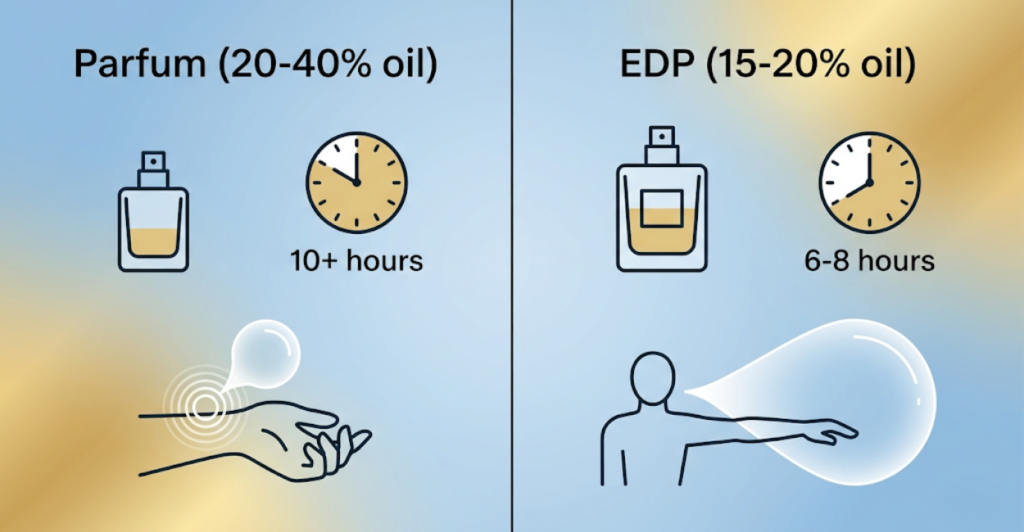
- Oil concentration: 20–40% (sometimes up to 50% in luxury niche)
- Longevity: 8–12+ hours (can last through a full day and night)
- Projection: Surprisingly low to moderate. Parfum sits close to the skin after the first hour. It is intimate, not loud.
- Application: One or two small dabs (not sprays, though many come with sprayers now).
Why choose Parfum?
- You want all-day performance without reapplying.
- You prefer a scent that stays close to you (not announcing your arrival).
- You appreciate the richest, most nuanced version of a fragrance (base notes are emphasized).
- You are buying a signature scent for special events.
Example fragrances:
- Chanel No. 5 Parfum (the legendary original)
- Tom Ford Private Blend (many are EDP strength, but some like Tobacco Oud have Parfum versions)
- Roja Dove Parfums (most are extrait concentration)
Pro tip: Parfum is often sold in smaller bottles (15ml, 30ml) because you need very little. Do not be shocked at the price per ml – it is the most economical in terms of cost per wearing.
💧 Eau de Parfum (EDP) – The Sweet Spot for Most People
What it is: The most popular concentration in modern perfumery. EDP balances longevity, projection, and price. It is what most people mean when they say “perfume.”
Key characteristics:
- Oil concentration: 15–20% (sometimes 12–18% in mass market)
- Longevity: 5–8 hours (easily a full workday)
- Projection: Moderate – people at arm’s length can smell you for 1–2 hours, then it becomes closer.
- Application: 2–4 sprays are typical.
Why choose EDP?
- You want a single application to last through work and dinner.
- You like your scent to be noticeable but not overwhelming.
- You are buying a versatile, everyday fragrance.
- You want the best value for money (most performance per dollar).
Example fragrances:
Pro tip: If a fragrance is available in both EDT and EDP versions, the EDP will usually have a richer, sweeter, or woodier character. The EDT will be brighter and more citrus/herbal. Test both – they can smell like completely different perfumes.
🌿 Eau de Toilette (EDT) – The Classic Everyday Choice
What it is: Historically, “toilette” referred to the act of grooming. Eau de Toilette was a light, refreshing splash applied after shaving or bathing. Today, it is the standard entry‑level concentration for most designer fragrances.
Key characteristics:
- Oil concentration: 5–15% (typically 8–12%)
- Longevity: 3–5 hours (expect to reapply at lunch)
- Projection: Light to moderate – noticeable within 1–2 feet for the first hour, then becomes a skin scent.
- Application: 3–6 sprays, sometimes more.
Why choose EDT?
- You prefer fresh, citrus, or aquatic scents (these work better at lower concentrations).
- You live in a hot or humid climate (heavy fragrances can be cloying).
- You work in close quarters (office, hospital, airplane) and do not want to offend.
- You are on a budget but still want a quality fragrance.
Example fragrances:
- Acqua di Gio EDT (Giorgio Armani)
- Dior Fahrenheit EDT
- Versace Pour Homme EDT
Pro tip: EDTs are excellent for layering. Spray an EDT over an unscented moisturizer, or layer it with a matching EDP or body lotion to boost longevity without becoming too heavy.
🍊 Eau de Cologne (EDC) – The Original Fresh Splash
What it is: Cologne originated in Cologne, Germany, in the 18th century. The original “Eau de Cologne” (Farina) was a light, citrus‑herbal blend. Today, the term is often misused – many “colognes” marketed to men are actually EDT or EDP strength.
True Eau de Cologne:
- Oil concentration: 2–5%
- Longevity: 2–3 hours at best
- Projection: Very light – a personal scent bubble
- Application: Splash generously (10–20 sprays or splashes)
Why choose EDC?
- You want a refreshing, non‑persistent scent for after the gym or shower.
- You enjoy classic, simple compositions (citrus, rosemary, neroli, lavender).
- You like to reapply frequently (it is meant to be used liberally).
- You are looking for an affordable, everyday “pick‑me‑up.”
Example fragrances:
- 4711 Original Eau de Cologne (the classic)
- Acqua di Parma Colonia (a higher quality interpretation)
- Roger & Gallet Jean Marie Farina
Pro tip: Do not confuse “Cologne” as a men’s fragrance category. Women have worn Eau de Cologne for centuries. The term refers to concentration, not gender.
💦 Eau Fraiche – The Lightest of Them All
What it is: Even lighter than Eau de Cologne. Eau Fraiche (French for “fresh water”) typically contains only 1–3% perfume oil. The rest is mostly water and alcohol, sometimes with a cooling agent like menthol.
Key characteristics:
- Oil concentration: 1–3%
- Longevity: 1–2 hours (sometimes less)
- Projection: Minimal – only you can smell it unless someone hugs you.
- Application: Splash or spray generously; you cannot overapply.
Why choose Eau Fraiche?
- You want a barely‑there scent for bedtime or post‑shower freshness.
- You are sensitive to strong fragrances.
- You like the ritual of fragrance without commitment.
- You need a cooling, refreshing body splash for hot summer days.
Example fragrances:
- Most “body sprays” from Bath & Body Works (though they are not called Eau Fraiche, the concentration is similar)
- Some niche brands like L’Occitane’s Eau de Toilette (actually closer to Eau Fraiche in performance)
Pro tip: Do not expect Eau Fraiche to project or last. Use it as a refresher – keep a small bottle in your bag or car.
How to Choose the Right Concentration for You (Decision Flowchart)
Instead of guessing, follow this simple decision tree:
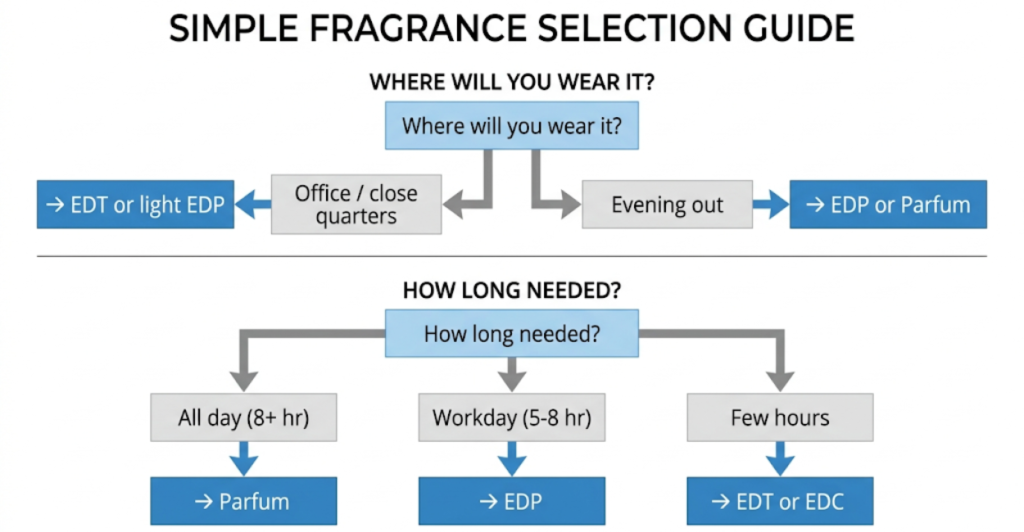
1: Where will you wear it?
- Office / close quarters → EDT or very light EDP (spray less)
- For evening out / date night, choose EDP or Parfum.
- On an outdoor summer day, go with EDT or EDC.
- During cold winter days, EDP or Parfum work better since they cut through cold air.
2: How long do you need it to last?
- If you need it to last all day (8+ hours) without reapplying, pick Parfum or heavy EDP.
- For a workday (5–8 hours), EDP is a solid choice.
- Just a few hours (lunch, errands)? Go with EDT.
- A quick refresh (gym, after shower) calls for EDC or Eau Fraiche.
3: What is your budget?
- High ($150+) → Parfum (small bottle) or EDP (large bottle)
- In the medium range ($60–120), consider EDP or EDT.
- On a low budget ($20–50), EDT, EDC, or Eau Fraiche are your best bets.
4: Do you prefer strong projection or intimate scent?
- Want people to notice you from across the room? Use EDP (spray more) – but be careful, it can be too much.
- If you want only you (or a partner) to smell it, Parfum (after dry‑down) or EDT (light sprays) works well.
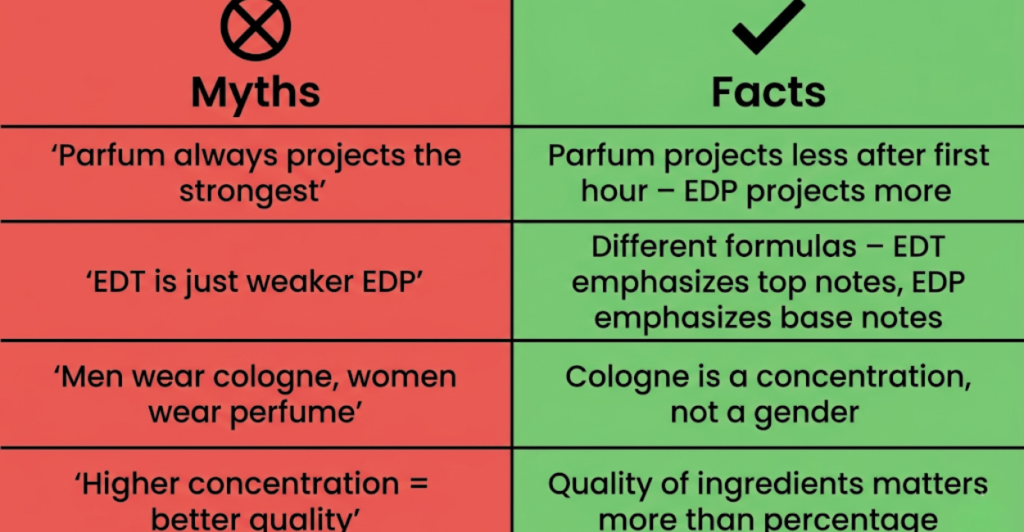
Common Myths About Fragrance Concentrations – BUSTED
| Myth | Truth |
|---|---|
| “Parfum is always the strongest projecting.” | No. Parfum projects less after the first hour because it evaporates slowly. It is a skin scent. EDP often projects more. |
| “EDT is just a weaker version of EDP.” | Not exactly. Many brands change the formula – EDT emphasizes top notes (citrus, fresh), EDP emphasizes heart and base notes (woodsy, sweet). They can smell different, not just weaker. |
| “Men wear Cologne, women wear Perfume.” | False. “Cologne” is a concentration, not a gender. Many women’s fragrances are Eau de Cologne (e.g., 4711). Many men’s fragrances are EDP or Parfum. |
| “Higher concentration means better quality.” | Not always. You can have a cheap, synthetic oil at 25% concentration – it will last long but smell terrible. Quality of ingredients matters more. |
| “You should always buy the highest concentration available.” | No. If you love a fresh, citrus scent, a Parfum version will ruin it (citrus notes cannot survive high oil percentages). Match concentration to the fragrance style. |
| “Eau Fraiche is just watered‑down perfume.” | Yes, intentionally. It serves a purpose: ultra‑light, refreshing, non‑persistent. It is not a rip‑off if you understand what you are buying. |
Practical Tips to Make Any Concentration Last Longer
Regardless of which concentration you buy, these 7 tips will stretch your fragrance’s performance:
- Moisturize first. Apply unscented lotion or petroleum jelly to pulse points. Fragrance sticks to oil, not dry skin. This alone can add 1–2 hours.
- Spray on clothes (carefully). A light mist on your collar or scarf can last for days. Avoid delicate silks or light colors that may stain.
- Do not rub your wrists together. That crushes the top notes and accelerates evaporation.
- Target pulse points. Wrists, inside elbows, behind ears, base of throat, behind knees. These areas emit heat, which helps diffuse the scent.
- Layer the same scent family. Use a matching shower gel, lotion, and fragrance. This builds intensity without clashing.
- Store properly. Keep bottles in a cool, dark closet – not the bathroom. Heat, humidity, and light destroy perfume oils.
- Apply to hair (with caution). One spray on a hairbrush, then brush through. Alcohol can dry hair, so use hair mists when possible.
Frequently Asked Questions (FAQ)
❓ Is Eau de Parfum stronger than Parfum?
No. Parfum has a higher oil concentration (20–40% vs. 15–20% for EDP). However, EDP may project more in the first few hours because the alcohol evaporates faster, carrying the scent. Parfum stays closer to the skin but lasts much longer.
❓ Can I wear EDT in winter?
Yes, but you will need to reapply more often. Cold air slows evaporation, so an EDT may actually last slightly longer in winter than in summer – but it will still be lighter than an EDP.
❓ What does “Parfum de Toilette” mean?
It is a marketing term with no fixed definition. Usually, it means something between EDT and EDP (around 10–15%). Treat it as a strong EDT or weak EDP.
❓ Why do some expensive niche fragrances use “EDT” but charge $200+?
Because concentration is not the only factor. High‑quality natural ingredients (rose absolute, jasmine grandiflorum, real ambergris) cost thousands of dollars per kilo. A 10% concentration of premium materials can outperform a 30% concentration of cheap synthetics.
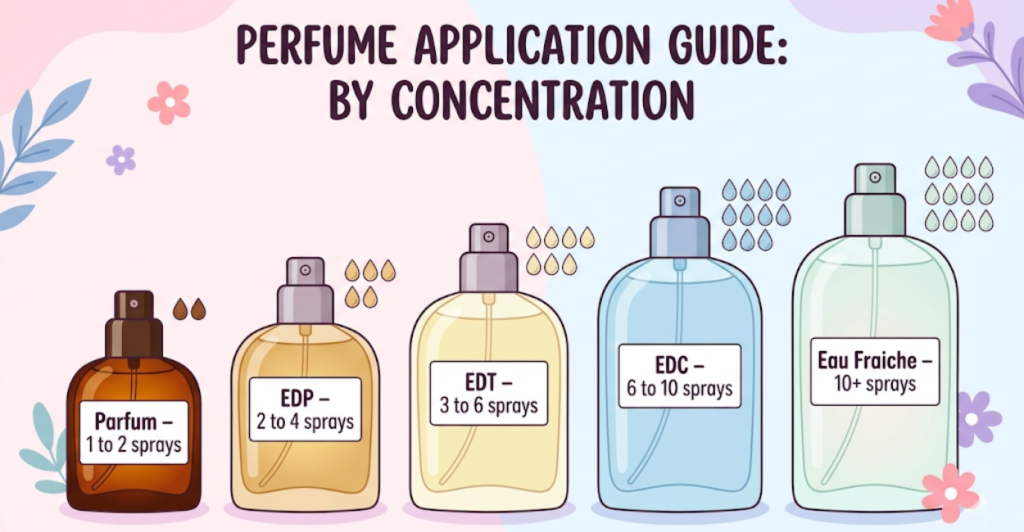
❓ How many sprays of each concentration should I use?
- Parfum: 1–2 sprays (dabs if non‑spray)
- EDP: 2–4 sprays
- EDT: 3–6 sprays
- EDC / Eau Fraiche: 6–10+ sprays (you can be generous)
❓ Can I mix different concentrations of the same fragrance?
Yes! This is called “fragrance layering.” For example, apply the EDP version as a base, then spray the EDT on top for extra freshness. Or use a Parfum for special occasions and an EDT for daily wear. They complement each other.
❓ Which concentration is best for sensitive skin?
Lower concentrations (EDT, EDC) have less perfume oil, so they may cause fewer reactions. However, the allergens are in the oil itself. Test on a small patch of skin first. Also, spray on clothes instead of skin.
❓ Does fragrance concentration affect the scent itself?
Yes, significantly. The same formula at different concentrations will smell different because the alcohol‑to‑oil ratio changes how fast notes evaporate. An EDT will highlight top notes (citrus, herbs). An EDP will highlight heart and base notes (florals, woods, vanilla). Always test the specific concentration you intend to buy.
Your Fragrance, Your Choice
Here is the revised version with more transition words:
You now understand everything about fragrance concentrations – from Parfum to Eau Fraiche. As a result, you can decode any bottle, set realistic expectations, and never be fooled by marketing terms again.
Quick recap:
- Parfum → Maximum longevity, intimate projection, premium price.
- EDP → Best balance of longevity, projection, and value for most people.
- EDT → Lighter, fresher, great for daytime and warm weather.
- EDC → Classic, refreshing, short‑lived – use generously.
- Eau Fraiche → Ultra‑light body splash, barely there.
Your next step: Look at any fragrance you already own. Check the concentration on the box. Now you know exactly what to expect – and whether you should spray twice or six times.
If someone asks you, “What is the difference between Parfum and Eau de Toilette?” – you can answer with confidence.
Did this cheat sheet help you? Share it with a friend who always complains that “perfume never lasts on me.” Or bookmark it for your next fragrance purchase.
Last updated: April 2026
Written by: Fragrance of Aroma – independent fragrance educators