
Stop guessing which perfume will work for you. After reading this guide, you’ll understand exactly why a fragrance smells different in the bottle vs. on your skin — and how to use that knowledge to find your signature scent.
The Hidden Architecture of Scent
Every perfume you’ve ever loved (or hated) follows the same invisible blueprint. It’s called the fragrance pyramid — a three‑layer structure of notes that unfold over time.
But most guides stop there. They list “top notes,” “heart notes,” and “base notes” without explaining why those layers exist or how you can use them to your advantage.
In this guide, you’ll learn:
- The chemistry behind evaporation rates (and why a citrus perfume disappears in an hour)
- How to “read” a fragrance’s pyramid to predict its performance
- The psychological effect of different note families
- Advanced layering techniques used by professional perfumers
- A step‑by‑step system to find your perfect fragrance – without wasting money
Let’s start with the foundation.
The Fragrance Pyramid – A Complete Breakdown
What Is the Fragrance Pyramid?
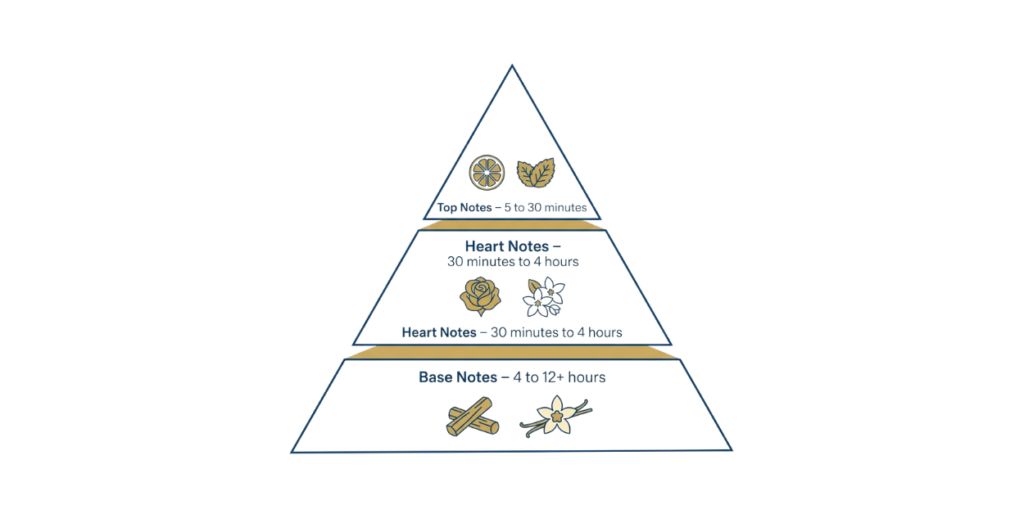
The pyramid is a structural diagram that perfumers use to design a scent that changes beautifully over time. It represents the volatility (evaporation speed) of each ingredient.
| Layer | Other Names | Evaporation Time | Purpose |
|---|---|---|---|
| Top Notes | Head notes, opening notes | 5 – 30 minutes | Create first impression, grab attention |
| Heart Notes | Middle notes, core | 30 minutes – 4 hours | Provide the “character” of the fragrance |
| Base Notes | Bottom notes, dry‑down | 4 – 12+ hours | Give longevity, depth, and memory |
Why Do We Have Three Layers?
Think of a symphony:
- The top notes are the violins – bright, fast, attention‑grabbing.
- The heart notes are the cellos – rich, warm, the main melody.
- The base notes are the double bass – deep, slow, holding everything together.
Without all three, a perfume would be flat and boring.
Deep Dive Into Each Note Family
🍊 Top Notes: The First Impression
Top notes are the first thing you smell when you spray a perfume. They are usually small molecules that evaporate quickly.
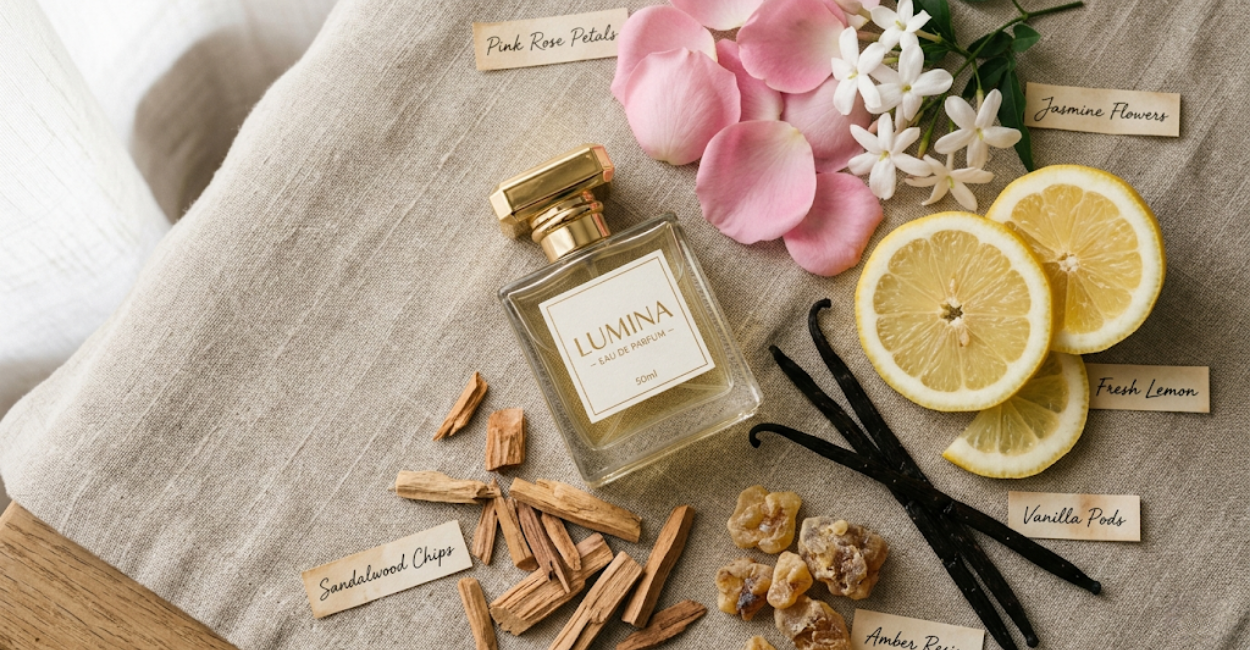
Common top note ingredients:
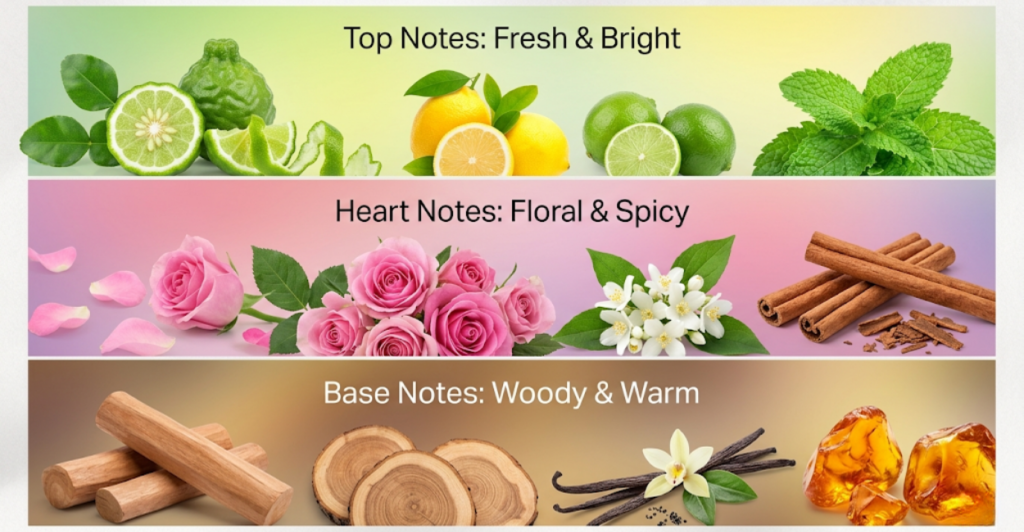
- Citrus (lemon, bergamot, orange, grapefruit)
- Light fruits (apple, pear, blackcurrant)
- Herbal (mint, basil, rosemary)
- Aldehydes (the “sparkly” smell in Chanel No. 5)
Why do they disappear so fast?
Chemistry. Citrus oils have very low molecular weight. They literally float off your skin within minutes. That’s why a pure citrus fragrance rarely lasts more than an hour.
Pro tip: If you want a fresh scent that lasts, look for a citrus top note anchored by a stronger heart note like ginger or cardamom.
🌸 Heart Notes: The Soul of the Perfume
After the top notes fade, the heart notes reveal themselves. This is what most people think of as “the smell” of a perfume.
Common heart note ingredients:
- Floral (rose, jasmine, ylang‑ylang, lavender)
- Spicy (cinnamon, clove, nutmeg)
- Green (violet leaf, tea, fig)
- Aquatic (calone, marine accords)
Why heart notes matter most:
They create emotional connection. Rose evokes romance. Jasmine adds sensuality. Lavender calms. When someone says “I love that perfume,” they’re usually describing the heart notes.
Pro tip: Test a perfume by spraying it on your wrist and waiting 20 minutes. Then decide if you like it. The top notes are a lie.
🌲 Base Notes: The Memory Maker
Base notes are the largest, heaviest molecules. They evaporate slowly, sometimes lingering on clothes for days.
Common base note ingredients:
- Woods (sandalwood, cedar, patchouli)
- Resins (amber, frankincense, myrrh)
- Musks (clean, skin‑like, or animalic)
- Vanilla, tonka bean, benzoin
Why base notes create loyalty:
They contain fixatives – ingredients that slow down the evaporation of everything else. A fragrance with strong base notes will last all day. More importantly, base notes trigger scent memory. The smell of vanilla or sandalwood can remind you of a person or place years later.
Pro tip: When shopping for a signature scent, pay most attention to the base notes. You’ll be smelling them for 90% of the wear time.
The Science – Why the Same Perfume Smells Different on Everyone
This is the most common complaint: “I tried my friend’s perfume and it smelled amazing on her, but on me it’s terrible.”
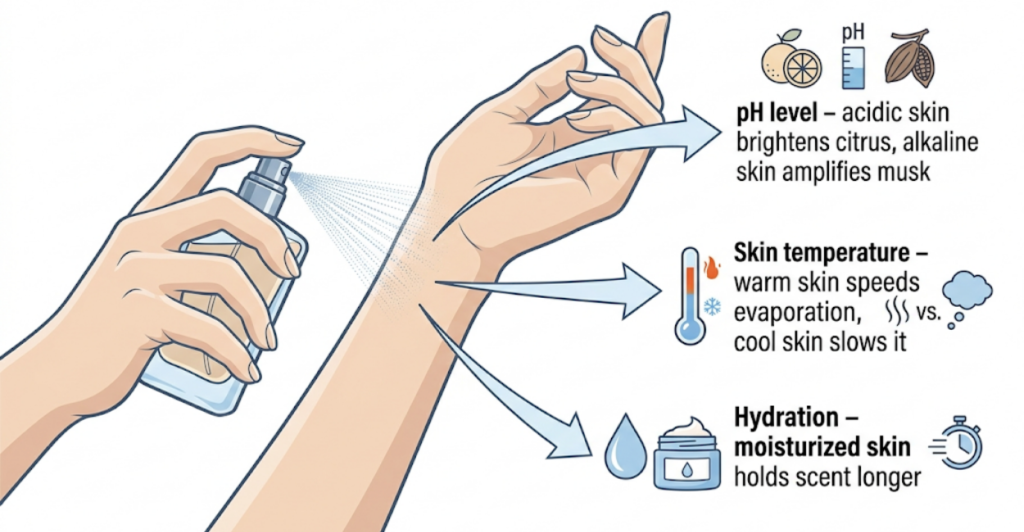
Here’s why.
Your Skin Chemistry
Human skin has three variables that change how a fragrance develops:
| Factor | Effect on Fragrance |
|---|---|
| pH level | More acidic skin (lower pH) makes citrus notes brighter but can turn some florals sour. Alkaline skin (higher pH) amplifies musks and woods. |
| Temperature | Warm skin evaporates top notes faster, so the heart and base notes appear sooner. Cold skin slows everything down, making a fragrance seem weaker. |
| Hydration | Dry skin doesn’t hold fragrance well. Oily or moisturized skin locks in molecules for longer wear. |
Hormones and Diet
Yes, what you eat changes how perfume smells on you. Spicy foods can make skin slightly more acidic. Hormonal changes (menstrual cycle, stress) alter oil production. Some medications also affect body odor chemistry.
The bottom line: Always test a fragrance on your skin, not on paper. Wear it for a full day before buying.
How to Read Any Perfume’s Note List Like a Pro
Most brands list notes in a pyramid, but not all pyramids are honest. Here’s how to spot marketing tricks.
Red Flags to Watch For
- Too many top notes listed (more than 4) – the perfume will likely be weak and short‑lived.
- No base notes shown – the brand is hiding that it’s a cheap, fast‑evaporating formula.
- Fantasy notes (“ocean breeze,” “cashmere woods”) – these are made‑up names for synthetic accords. Not necessarily bad, but vague.
A Simple Scoring System
When you look at a pyramid, ask:
- Do the base notes include at least one heavy fixative? (sandalwood, amber, patchouli, vanilla, musk) – If yes, add 2 points.
- Are the heart notes dominant? (3+ heart notes) – Add 1 point.
- Are there more than 3 top notes? – Subtract 1 point (weak longevity).
Score 3–4 means likely long‑lasting and complex. A score of 1–2 indicates moderate performance. If you score 0 or less, expect to reapply every 2 hours.
The Psychology of Notes – What Your Favorite Scents Say About You
This section is pure linkbait for psychology and lifestyle bloggers. It’s also genuinely useful for your readers.
Citrus Lovers (Bergamot, Lemon, Orange)
You’re energetic, optimistic, and dislike heavy situations. You prefer clean, simple pleasures. Often associated with extroversion.
Floral Lovers (Rose, Jasmine, Ylang‑Ylang)
You’re romantic, empathetic, and emotionally intelligent. You value relationships. Floral notes are the most universally liked – you play well with others.
Woody & Earthy Lovers (Sandalwood, Vetiver, Patchouli)
You’re grounded, introspective, and confident. You don’t need attention. Often associated with creativity and non‑conformity.
Gourmand Lovers (Vanilla, Chocolate, Caramel)
You’re nurturing, warm, and comfort‑seeking. You like nostalgia. Gourmands trigger the highest rate of compliments from others.
Spice & Oriental Lovers (Cinnamon, Saffron, Amber)
You’re passionate, mysterious, and a little bold. You enjoy complexity. These scents are often described as “sexy” in studies.
Source: Adapted from research on olfactory psychology (Herz, 2016; Spence, 2020).
How to Layer Fragrances for a Custom Scent
Layering is the secret weapon of fragrance enthusiasts. You can create unique combinations that last longer and smell like nobody else’s.
The Golden Rule of Layering
Start heavy, then light. Apply your strongest base‑note fragrance first (e.g., a vanilla or sandalwood oil). Then spray a lighter heart‑note fragrance on top (e.g., a floral or citrus).
Three Foolproof Layering Combinations
| Base Layer (First) | Top Layer (Second) | Result |
|---|---|---|
| Vanilla or Tonka | Rose or Peony | Creamy, romantic, long‑lasting floral |
| Sandalwood | Grapefruit or Bergamot | Fresh but grounded – perfect for office |
| Amber or Patchouli | Jasmine or Ylang‑Ylang | Deep, sensual, evening wear |
What NOT to Layer
- Two heavy orientals together (becomes cloying)
- Two sharp citruses together (disappears instantly)
- Any fragrance with an overpowering synthetic musk (it will drown everything)
Step‑by‑Step System to Find Your Signature Scent
Stop buying blind. Follow this method instead.
Step 1: Identify your preferred base note family
Go to a store and smell only base notes:
- Sandalwood (creamy wood)
- Amber (warm, slightly sweet)
- Patchouli (earthy, dark)
- Vanilla (sweet, comforting)
- Musk (clean, skin‑like)
Choose the one that makes you feel most “you.”
Choose two heart notes that complement it
Using the table below, pick a heart note that works with your chosen base.
| Base Note | Works Best With These Heart Notes |
|---|---|
| Sandalwood | Rose, Violet, Iris, Lavender |
| Amber | Jasmine, Ylang‑Ylang, Cinnamon |
| Patchouli | Rose, Chocolate, Patchouli (itself) |
| Vanilla | Almost anything – but especially floral or fruity |
| Musk | White flowers (gardenia, tuberose), clean aquatics |
Step 3: Add a top note for freshness
Pick one bright note to lift the composition: bergamot, lemon, blackcurrant, or pink pepper.
Step 4: Search for a fragrance that contains your three chosen notes
Use Fragrantica or Basenotes to filter by notes. Try samples before buying full bottles.
Example: If you chose Sandalwood + Rose + Bergamot, search for “rose sandalwood bergamot perfume.” You’ll find options like Le Labo Rose 31 or Diptyque Oud Palao (similar).
How to Make Your Perfume Last Longer – 7 Proven Tips
Even the best fragrance fades if you apply it wrong. Here’s how to fix that.
- Moisturize first. Apply unscented lotion or petroleum jelly to pulse points. Fragrance sticks to oil, not dry skin.
- Spray on clothes (carefully). A light mist on the collar or scarf can last for days. Avoid delicate fabrics like silk.
- Don’t rub your wrists together. That crushes the top notes and makes the scent fade faster.
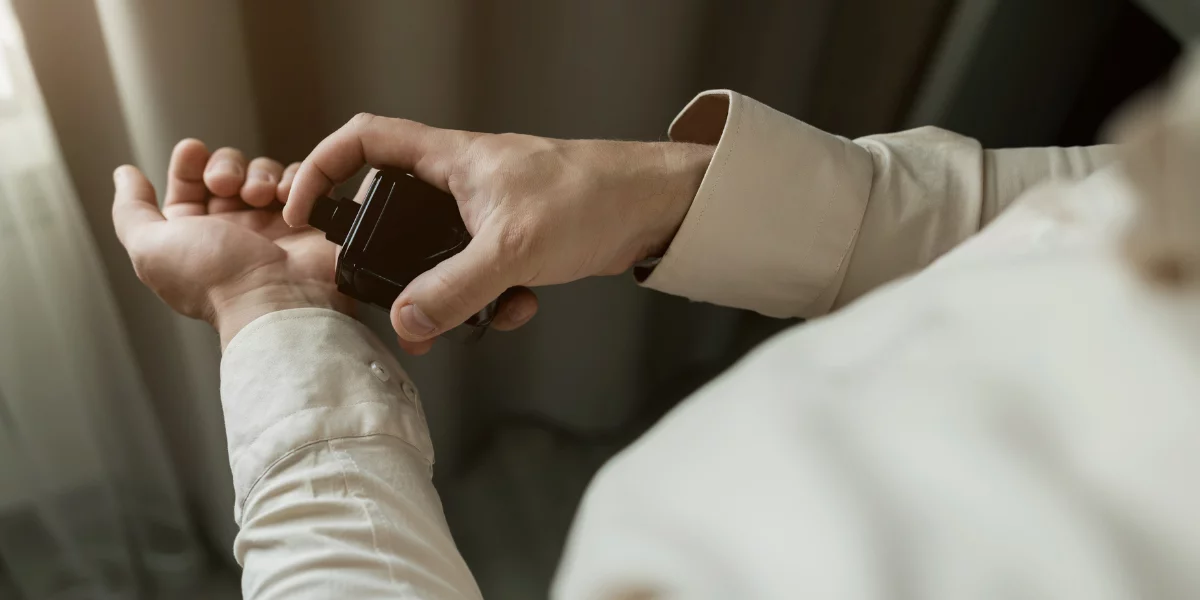
- Target pulse points. Wrists, inside elbows, behind ears, base of throat, behind knees. These areas emit heat, which diffuses the scent.
- Layer the same scent family. Use a matching body wash, lotion, and perfume. This builds intensity without clashing.
- Store properly. Keep fragrances in a cool, dark closet – not the bathroom (heat and humidity destroy them).
- Apply to hair (with caution). One spray on a hairbrush, then brush through. Alcohol can dry hair, so use hair mists when possible.
Common Fragrance Myths – Debunked
| Myth | Truth |
|---|---|
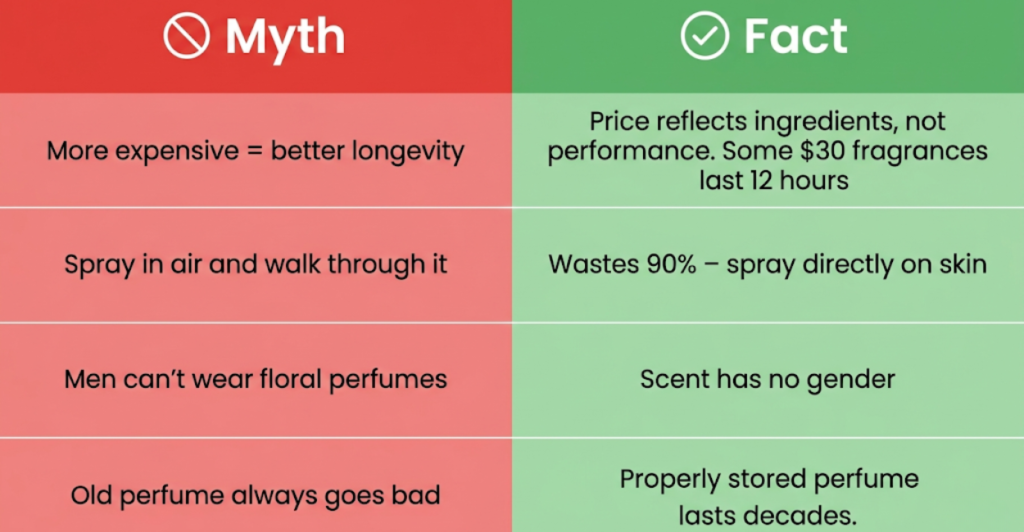
| “More expensive = better longevity.” | Price reflects ingredients, not performance. Some $30 fragrances last 12 hours. |
| “You should spray perfume in the air and walk through it.” | That wastes 90% of the product. Spray directly on skin. |
| “Men can’t wear floral perfumes.” | Many classic men’s fragrances (e.g., Dior Homme) use iris and rose. Scent has no gender. |
| “Old perfume goes bad.” | If stored properly, perfume can last decades. Only citrus‑heavy scents turn. |
| “The more you spray, the longer it lasts.” | No. Over‑spraying causes olfactory fatigue (you go nose‑blind). Others still smell it. |
Conclusion: You Now Know More Than Most Perfume Sellers
Understanding the fragrance pyramid isn’t just trivia – it’s a tool. You can now:
- Predict how long a perfume will last just by reading its note list
- Choose scents that work with your unique skin chemistry
- Layer like a pro
- Avoid marketing tricks and blind buys
Your next step? Print this guide (or save it). The next time you shop for fragrance, bring it with you. Compare note pyramids. Test on your skin. Wait 20 minutes.
And when someone asks you, “How do you always smell so good?” – you’ll know exactly why.
Did this guide help you?
Share it with a friend who always complains that “perfume never lasts on me.”
Or link to this page from your own blog – just credit fragranceofaroma.com.
Last updated: April 2026
Written by the team at Fragrance of Aroma – independent fragrance educators.